
5 Lessons from Crypto Scam Victims and the Role of AI
Crypto scam analysis based on FBI 2024 data: $9.3 billion lost. Learn to spot Pig Butchering, fake platforms and AI deepfakes before becoming a victim.
An analysis based on official reports from California’s DFPI and FBI 2024 data
Introduction: The Promise and the Abyss
The appeal of cryptocurrency investment is undeniable: a new frontier of financial opportunities with the potential for exponential gains. Yet this mass enthusiasm has created fertile ground for incredibly sophisticated scams that exploit investors’ hope and trust.
This article is not a simple warning. It is the result of analyzing hundreds of official reports from the California Department of Financial Protection and Innovation (DFPI) and FBI data published in its 2024 IC3 report.
The figures are devastating: $9.3 billion lost to crypto fraud in 2024 alone. Of that, $5.8 billion corresponds to Pig Butchering investment scams. And most disturbing of all: according to the FBI’s Operation Level Up, 77% of the victims contacted didn’t know they were being scammed.
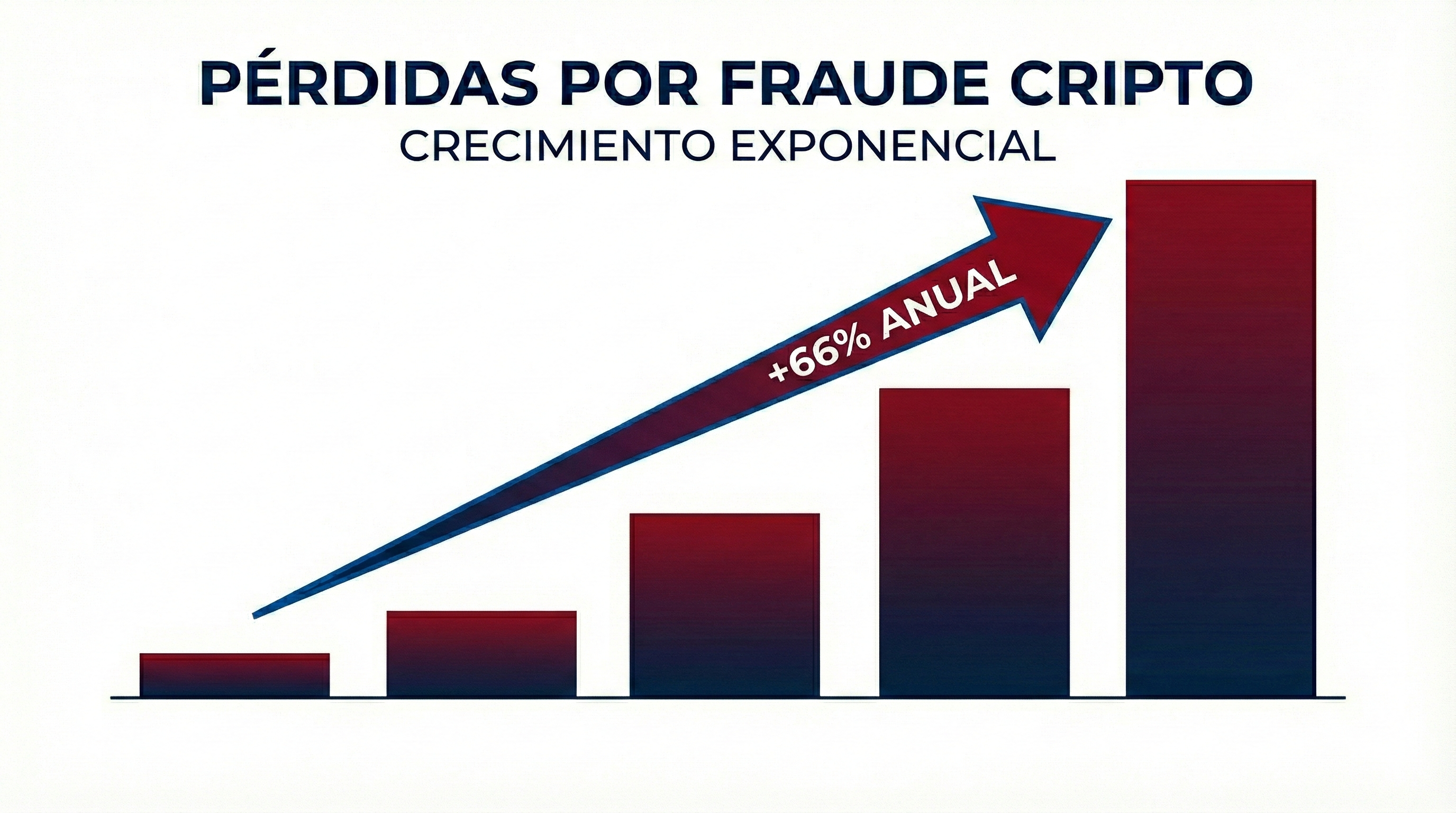 Evolution of crypto fraud losses according to the FBI IC3. From $2.5 billion in 2022 to $9.3 billion in 2024, a 66% year-over-year increase.
1. Pig Butchering Doesn’t Start With Money, But With Trust
The term Pig Butchering describes a scam where the criminal first establishes a relationship —romantic, social or business— to win the victim’s trust before introducing a supposed investment opportunity.
The most counterintuitive point the reports reveal is that the most devastating scams don’t begin with a financial pitch, but with meticulous emotional manipulation. This fattening phase is designed to isolate the victim from their support network, establish the scammer as the main source of trust, and prepare the ground for financial exploitation.
Scammers contact their victims in places where people let their guard down: dating apps like Tinder or Bumble, professional networks like LinkedIn, and social media like Instagram or Facebook. Once contact is established, they quickly move the conversation to private messaging apps like WhatsApp or Telegram. There, over weeks or even months, they build a relationship of trust.
DFPI records include cases like a victim contacted on Instagram by a stranger who then asked them to move the conversation to WhatsApp. In another documented case, a victim met someone on a dating app who promised to teach them how to trade crypto assets to fund their future together.
2. Fake Platforms Follow a Predictable Script
Once trust is gained, fraudulent trading platforms operate with a surprisingly consistent modus operandi. The pattern is as repetitive as it is effective.
First comes the hook: a supposed friend or trusted advisor introduces a trading platform that looks professional, exclusive and highly profitable. Then the test: they invite the victim to deposit a small amount to try the system. Then the demonstration: the platform shows impressive gains and, crucially, allows the victim to make a small successful withdrawal.
This moment is key because it removes doubts. DFPI reports include an illustrative case of a victim who was operating on web3app.rest. They were able to withdraw a small amount at first, which encouraged them to deposit a much larger sum. They never saw that money again.
Encouraged by the initial success, the scammer pressures the victim to invest much larger sums, often including retirement savings or loans. Finally, once a substantial sum has been invested, the platform blocks every withdrawal attempt.
3. AI Is Creating Superhuman Scammers
If psychological manipulation is the engine of these scams, artificial intelligence is a force multiplier that enables a scale and sophistication previously unthinkable.
Scammers already use AI software to send thousands of messages per minute and find potential victims. A single operator can hold seemingly personalized conversations with dozens of victims simultaneously. According to a study by McAfee published in February 2025, 1 in 4 people has been contacted by an AI chatbot posing as a real person on dating apps or social media.
Today’s chatbots can hold fluid 24/7 conversations, remember details from earlier exchanges, adapt their emotional tone to the victim’s responses, and escalate emotional intimacy gradually. A 2025 report from the Centre for Emerging Technology and Security documents how these chatbots automate the relationship-building phases, imitating human behavior with unsettling precision.
But the most shocking case involves deepfake technology. In January 2024, a finance employee at the British firm Arup (responsible for iconic structures like the Sydney Opera House) was tricked into transferring $25 million after a video call in which every participant was a deepfake: the CFO and several colleagues the employee believed he recognized.
The employee initially suspected the email was phishing, but the video call with people he thought he recognized removed his doubts. He made 15 transfers to 5 different bank accounts before discovering the deception by checking with head office. CNN covered the case in detail, and Arup later confirmed it was the victim.
 How the Arup scam worked: an initial suspicious email, a video call with multiple deepfakes of the CFO and colleagues, 15 transfers to 5 bank accounts, $25 million lost.
4. The Fake Tax and Fee Scheme: The Final Trap
When a victim finally tries to withdraw their supposed gains, they hit the most desperate phase of the scam.
Almost universally, fraudulent platforms block withdrawals and demand additional payments under a variety of pretexts: taxes on gains that conveniently cannot be paid with the account balance, service fees or mining commissions, claims that the account is frozen for suspicious activity and requires a security deposit, or requirements to pay for a VIP membership to enable withdrawals.
The initial money is already lost. These pretexts are simply tactics to extract even more funds. This is a deliberate exploitation of the sunk-cost fallacy: victims, having already lost so much, cling to the hope that one more payment might recover their investment. Scammers know this and exploit it mercilessly.
The DFPI has a devastating case of a victim whose balance on Qexbit.org supposedly exceeded $3 million, but who was required to pay a $245,000 service fee to withdraw their funds.
A legitimate platform will never ask you to pay fees with outside money to release your own funds.
5. Your Best Defense Is Still Analog
In an increasingly deceptive digital world, the most robust countermeasures remain fundamentally human. Technology helps, but personal caution is irreplaceable.
Red flags you must not ignore: unexpected contact from an attractive stranger on social media, suggestions to move the conversation to WhatsApp or Telegram quickly, promises of guaranteed or risk-free returns, pressure to act fast because the opportunity is supposedly running out, and trading platforms that don’t appear in official registries or cannot verify licenses with regulators.
Concrete actions you can take: Before depositing a single euro on any platform, look it up in the DFPI Crypto Scam Tracker. If your new contact’s profile picture looks too perfect, run a Google reverse image search; scammer photos are usually stolen or AI-generated.
Set up safe words with close family members to verify identities on urgent calls asking for money. If you suspect you are on a video call with a deepfake, ask the person to do something simple like wave a hand in front of their face; today’s deepfakes still glitch with unexpected movements.
For daily use, consider installing browser extensions that detect crypto phishing sites in real time. At the end of this article I share some free tools that can help you.
If You’ve Already Been a Victim: What to Do Now
Many scam articles only warn, but never tell you what to do when it has already happened. If you suspect you’ve fallen into a scam or you already know for certain, these are the steps you must follow immediately.
Stop sending money. It sounds obvious, but many victims keep paying supposed fees or taxes hoping to recover something. Every extra euro you send is lost. No matter what they tell you, no matter how much you have locked on the platform. Cut off the flow of money right now.
Document everything before it disappears. Scammers delete conversations and shut down websites without warning. Take screenshots of every message, email, the trading platform, your transactions, the wallet addresses you sent funds to, and any contact details you have. Also save your bank or exchange transfer histories.
Contact your bank or exchange immediately. If you sent money by bank transfer, call your bank and explain you’ve been the victim of fraud. Some transfers can be reversed if you act quickly. If you used an exchange like Coinbase, Binance or Kraken, contact their support and report the destination addresses as fraudulent.
File an official report. In Spain you can report to the National Police or Guardia Civil. In the United States, report to the FBI through IC3. Either way, the report creates an official record that can be useful for future investigations or for tax loss deductions.
Watch out for recovery services. After a scam, companies often appear promising to recover your funds in exchange for a commission. The vast majority are a second scam. The FBI and law enforcement don’t charge to investigate, and no private company has magic powers to recover crypto sent to scammer wallets.
Seek support. This type of scam causes severe emotional harm. Many victims feel shame and don’t talk to anyone. According to the FBI, 64 victims contacted by Operation Level Up were referred to specialists for suicide risk. You are not alone, and what happened to you is not your fault. Talk to someone you trust.
How to Vet a Platform Before Investing
Before depositing money on any crypto trading or investment platform, spend 15 minutes on these checks. They can save you thousands of euros.
Search the platform in scam databases. California’s DFPI Crypto Scam Tracker contains thousands of platforms reported as fraudulent. Search the exact name and also variations. Scammers often change a letter or add numbers to the domain.
Check the age of the domain. Fraudulent platforms usually have domains registered just weeks or months ago. You can verify this on WHOIS Domain Tools or Who.is. If the domain is less than a year old and they promise spectacular returns, be suspicious.
Verify licenses and official registries. A legitimate trading platform must be registered with the financial regulator of its country. In Spain it is the CNMV, in the United States the SEC or FINRA, in the United Kingdom the FCA. Go directly to the regulator’s website and search for the company. Don’t trust logos or links shown on the suspect platform itself.
Look for reviews outside the platform. Search Google for the platform name followed by “scam”, “review”, or “complaints”. Check Reddit, Trustpilot and specialized forums. If you can find absolutely nothing about the platform, that is also suspicious. Legitimate platforms have a presence and verifiable reviews.
Analyze the website. Scam sites usually have grammatical errors, generic text copied from other websites, and vague or non-existent contact information. If there is no physical address, customer service phone, or clear legal information, it’s a serious red flag.
Try a withdrawal before investing seriously. If you decide to test a platform with a minimal amount, try to withdraw that money before depositing more. If the withdrawal goes through without issue, it doesn’t mean the platform is safe, but if they obstruct a small withdrawal, you know it’s a scam.
Free Resources to Protect Yourself
Before we finish, I want to share tools I use and recommend. They are all free:
- DFPI Crypto Scam Tracker — Official database with thousands of fraudulent platforms reported. Your first stop before investing anywhere.
- WHOIS Lookup — To check when a domain was registered. If it is less than a year old and promises incredible returns, run.
- Brújula Security — A Chrome extension that automatically analyzes every site you visit and alerts you in real time if it detects crypto phishing patterns, suspicious domains or wallet draining attempts. It runs in the background without you having to do anything.
- Google Reverse Image Search — To check if your new contact’s profile photo has been stolen from the internet or generated by AI.
These tools don’t replace common sense, but they add an extra layer of protection that can spare you a lot of pain.
Conclusion: The New Frontier of Trust
Crypto scams have become a dangerous fusion of timeless psychological manipulation and cutting-edge artificial intelligence. The battle is no longer just against human greed, but against algorithms designed to exploit our vulnerabilities at a scale never seen before.
To put the figures in perspective: $9.3 billion in total losses in 2024, $5.8 billion in Pig Butchering scams alone, a 66% increase over the previous year. People over 60 are the most affected group, with average losses of $140,000 per victim.
In a world of deepfakes and AI chatbots, how will we verify who we can truly trust online? The answer starts with education, verification tools and, above all, the willingness to question what seems too good to be true.
Additional material: If you want to go deeper, we’ve published a detailed forensic analysis of a real scam using AI bots, including screenshots, wallet addresses and the step-by-step modus operandi. Download it here Brujula Crypto PDF Forensic Analysis: The Fake AI Bot Scam
Related articles

Web3 without seed phrase: smart wallets and traceable money
How Web3 leaves the seed phrase behind and enters the era of smart wallets, passkeys and verified identity on the way back to the bank.

Silicon Deception: The New Era of AI-Powered Crypto Scams and How to Protect Your Wallet in 2025
Crypto scams have evolved. Generative AI, voice cloning and Wallet Drainers are emptying wallets. Learn to spot the threat and defend yourself with simulation tools and the Zero Trust mindset.

Ultimate DeFi Security Guide (2025): Protect Your Crypto Assets
Learn about DeFi security. This guide teaches you how to avoid rug pulls, understand impermanent loss and protect your crypto with advanced OpSec.
Tags
Comments
What did you think about this article?
Share your experience and help fellow crypto navigators.
Information That Protects Your Capital.
Stay protected: receive free monthly alerts about new crypto threats, exclusive security guides, and practical resources to safeguard your funds. Your shield against fraud.