
Silicon Deception: The New Era of AI-Powered Crypto Scams and How to Protect Your Wallet in 2025
Crypto scams have evolved. Generative AI, voice cloning and Wallet Drainers are emptying wallets. Learn to spot the threat and defend yourself with simulation tools and the Zero Trust mindset.
🧠 Silicon Deception
Imagine your phone rings. It’s your daughter’s voice, frantic, crying. “Mom, I’m in trouble, I had an accident and they arrested me. I need money for bail.” Panic takes hold of you. The voice is identical. Every inflection, every nuance of desperation. It’s her. You have no doubt. You send the money to the crypto wallet they tell you.
Except it wasn’t your daughter.
 Or imagine this other scenario: it’s 3 AM and an airdrop transaction fails. You look for help on Discord and a support agent answers instantly. They’re kind, professional, and use perfect technical jargon. They patiently guide you to sync your wallet on a website. The moment you sign the verification, all your funds disappear. That agent wasn’t human, it was a Large Language Model (LLM) trained to scam.
Welcome to 2025, where Synthetic Social Engineering doesn’t just create art; it has handed cybercriminals an arsenal of dystopian science-fiction tools. The case of the woman scammed out of $15,000 after hearing her cloned daughter’s voice is not an isolated anecdote; it’s the new frontier of fraud.
The old phishing scams with badly written emails are dead. The new threat is a perfect scam: a hyper-convincing, AI-powered attack designed with a single purpose: to trick you into signing a transaction that will drain every asset from your cryptocurrency wallet instantly.
We’re not talking theory. The numbers are overwhelming. 2024 and 2025 reports from firms like Scam Sniffers, Elliptic and ScamWatchHQ put wallet drainer losses in the hundreds of millions, while losses tied to AI deepfakes reached $4.6 billion in 2024 alone. Reports co-authored by Bitget and SlowMist confirm that deepfakes drove 40% of high-value scams, and the FBI itself put total crypto scam losses at nearly $16.6 billion.
This is not another theoretical guide. This is a digital survival manual. Based on dozens of security reports from leading firms like Darktrace, F5, Norton, Elliptic and CertiK, we will break down the anatomy of this threat. We will reveal how the bait works, what exactly a wallet drainer is and, most importantly, we will give you a practical, actionable defense shield.
Because in 2025, the security of your wallet no longer depends on a long password, but on your active skepticism and the tools you use to verify reality.
📈 The Problem: Figures, Scale and Industrialization
Before diving into the technical how, it’s vital to understand the scale. We’re not talking about small isolated thefts. We are witnessing organized, industrialized and technologically advanced crime.
- Hundreds of Millions Drained: Blockchain analytics firm Elliptic reports that crypto scams remain a multi-billion dollar problem. Within this ecosystem, wallet drainers have become the tool of choice for their chilling efficiency.
- AI as Accelerator and Force Multiplier: Norton identifies the use of AI and deepfakes as one of the main emerging threats for 2025, noting that more than 580 new AI-generated malicious websites appear daily.
- The Rise of Drainer-as-a-Service (DaaS): The entry barrier for criminals has collapsed. They no longer even need to know how to program. As Group-IB details, cybercriminals can rent wallet drainer kits on the dark web, complete with control panels and technical support, in exchange for a 20-30% commission on the loot. TRM Labs calls it Drainware.
The strategic target has shifted. While the theft of private keys still happens, it’s hard. The new target is more subtle, more psychological and much more scalable: trick you into giving them permission to rob you yourself.
🔬 Anatomy of the Perfect Scam: Synthetic Social Engineering
The modern scam is a two-phase attack that combines the most basic human psychology with the technical vulnerability of blockchain interactions.
Phase 1: The Bait (Generative AI as a Weapon)
The first step is to make you bite. AI has made the bait go from obviously fake to almost indistinguishable from reality.
1. Voice Cloning and Deepfakes: The Emotional Deception
The entry barrier to create an audio or video deepfake is now non-existent.
- The How: Platforms like ElevenLabs, Resemble AI or HeyGen allow you to clone a voice with astonishing quality from just a few seconds of audio (obtained from a TikTok, a reel, or a podcast). The new threat is real-time Speech-to-Speech: a scammer speaks, and the AI repeats it with your loved one’s voice instantly.
- The Attack: As McAfee warns, scammers use these cloned voices to impersonate loved ones in panic calls. The key is urgency. The attack is designed to activate your limbic system, overriding your logical thinking.
2. Synthetic Support Agents: The Friendly Enemy
This is the newest vector. LLMs (Large Language Models) trained as technical support agents. You look for help on Discord or Google and find an AI bot that is kind, patient and guides you to solve your problem. Its sole goal is to convince you to visit a phishing site and sign a malicious transaction.
3. Spear Phishing 2.0: Hyper-Personalized Phishing
Forget the Nigerian Prince. Generative AI combines Off-Chain data (your social media posts) with On-Chain data (your public history on Etherscan).
- The Attack: The AI creates bait with terrifying credibility: “Hi, we noticed your wallet [0x123…] interacted with the Airdrop contract for [ProjectX] on Tuesday, but the transaction failed. Please visit our support portal [PhishingLink] to validate your claim.” The attack is based on real, verifiable facts, manipulating your trust.
Phase 2: The Weapon (Ice Phishing and Wallet Drainers)
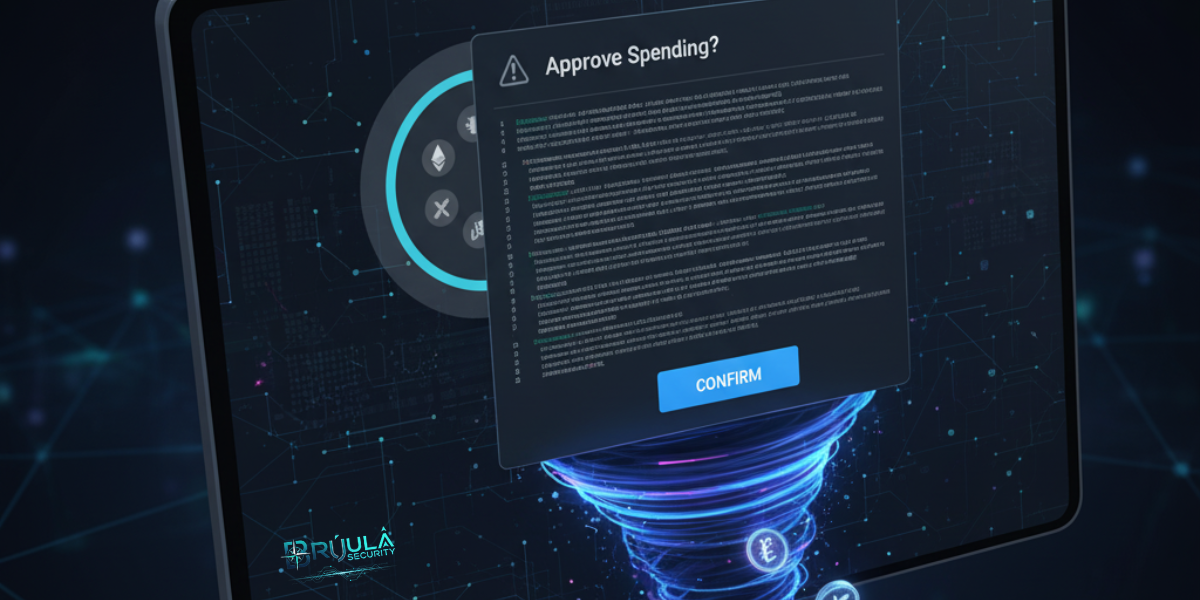 This is where most people fall. You click the link, you connect your wallet. You think you’re interacting with a legitimate site. But in reality, you’re about to authorize a robbery.
This is not a hack in the traditional sense. They haven’t broken your password. It’s a manipulation of consent.
Scammers trick you into signing one of two types of malicious transactions, both devastating.
1. Ice Phishing or Token Approval (The Partial Blank Check)
This is the most common tactic. It’s “Ice Phishing” because the scammer doesn’t ask for your key, but tricks you into signing a permission.
- The Concept: For a DApp like Uniswap to interact with your tokens, you must first give it permission or approval (
setApprovalForAll). It’s a necessary step in DeFi. - The Scam: The phishing site (or the Synthetic Agent) asks you to “approve” or “verify” your wallet. The contract you are approving is malicious. As TrustWallet warns, your wallet’s pop-up will ask you to approve spending of your tokens. If you don’t read the details, you are likely signing an approval for an unlimited amount (
max_uint256) of your tokens. - The Result: You have given the scammer’s contract a blank check on your tokens. Whenever they want, they drain all the tokens of that type (all your USDC, all your WETH) out of your wallet. Darktrace has extensively documented how these “trap” campaigns are used.
2. The eth_sign Signature (The Definitive Blank Check)
This is the nuclear option of scams. It’s rarer, but much more dangerous.
- The Concept:
eth_signis a very old and dangerous signing method. Unlike normal transaction signatures (which show you structured data),eth_signcan sign any type of data. - The Scam: As SlowMist masterfully explains, the scammer presents you with a message that looks harmless (“Verify your wallet”). Your wallet (especially older ones) will show you an unreadable signature warning.
- The Result: If you sign, you have lost the game. With that signature, the scammer can essentially impersonate you and build transactions on your behalf. It’s the equivalent of giving them the keys to your house. Most modern wallets, like MetaMask, now show full-screen bright red warnings if a site tries to use
eth_sign.
Nasdaq and Coinbase are publishing guides for beginners, but smart contract manipulation attacks are becoming increasingly complex.
The Case Study: Anatomy of a Drain (The Ice Phishing Attack)
The Mass Loss Event (April 2025): Although many individual hacks are hidden out of shame, industry reports aggregate the losses. In April 2025, the cybersecurity community tracked a catastrophic event: a single victim lost 3,520 BTC (worth approximately $330 million) in a sophisticated social engineering attack. Although initial reports attributed this to a human scam call center, this event was the manual launch that served as a proof of concept. Synthetic Agents and AI-based drainers are the automated mass production of this same attack.
The Technical Vector: It’s Not a Hack, It’s Ice Phishing
To understand how this attack works, we must differentiate it from traditional phishing.
- Traditional Phishing: Tricks you into revealing your seed phrase or private key.
- Ice Phishing: It’s more subtle. It doesn’t ask for your seed. It tricks you into signing a transaction that grants permissions to the scammer’s smart contract.
The main weapon in the Ice Phishing arsenal is a legitimate smart contract function called setApprovalForAll.
When you list an NFT for sale on a marketplace like OpenSea or Magic Eden, or when you deposit your tokens in a DeFi protocol like Aave, you must sign a setApprovalForAll transaction. This transaction is essentially you telling the blockchain: “I trust the OpenSea smart contract to move my NFTs for me when someone buys them.” It is a necessary function for Web3 to work.
The Synthetic Support Agent exploits this. It directs you to a phishing site and tells you: “Please sign this transaction to verify your wallet and sync it with our new security router.” The user, who has been trained to never share their seed, mistakenly thinks signing a message is safe.
But the transaction they sign is not a verification message. It is a setApprovalForAll transaction that designates the scammer’s smart contract as an approved operator for all your tokens and NFTs (ERC-20s, ERC-721s, etc.).
The Execution: The Wallet Drainer-as-a-Service (DaaS)
The attack unfolds in three phases:
- The Deception (Synthetic Social Engineering): The AI agent (whether by voice or text) calms the victim, answers their technical questions and convinces them to sign the verification transaction.
- The Signature (The Ice Phish): The victim signs the
setApprovalForAlltransaction. At this precise moment, no money has been stolen yet. The victim’s wallet has become a time bomb. - The Drain (DaaS): The scammer’s contract now has unlimited permission to take the assets. The scammer’s backend, a malicious script known as a Wallet Drainer, activates automatically. This script sweeps or drains the victim’s wallet, transferring all valuable assets to a scammer-controlled wallet.
To make matters worse, the criminal ecosystem has professionalized. The scammer operating the Synthetic Agent probably didn’t even write the drainer software. They simply rented it from a Drainer-as-a-Service (DaaS) or Drainer Templates as a Service (DTaaS) platform, like the infamous Monkey Drainer or Zentoh. These platforms provide the phishing kit and the drainer script in exchange for a 20-30% commission on the loot.
The truly diabolical genius of this scam is that it separates the act of trust from the consequence. In a seed phishing scam, the act (giving the seed) and the consequence (losing funds) are immediate. Ice Phishing is more insidious. The victim signs the transaction, checks their balance and sees that all their money is still there. They believe they are safe. The Synthetic Support Agent might even say: “Great! The verification is in process. The system will re-sync it in the next 24 hours. Thank you for your patience.” The agent says goodbye politely.
Hours later, while the victim sleeps, the drainer script executes. This breaks the victim’s feedback loop. When they realize the scam, the scammer and the AI agent are long gone.
🛡️ The 2025 Defense Manual: How to Protect Your Wallet
The bad news is that the attacks are incredibly sophisticated. The good news is that the defense, although it requires a mindset shift, is accessible to everyone.
Your new mantra should be: Active Paranoid Verification.
This is the core of Zero Trust architecture, but taken to the next level. Never trust, always verify.
Here is the three-pillar defense shield.
Pillar 1: The Zero Trust Mindset (The Human Shield)
Your brain is the first line of defense, and the most important.
- NEW GOLDEN RULE: Support will NEVER contact you first. This is the absolute golden rule. Legitimate technical support in Web3 is reactive, not proactive. They will NEVER send you a Direct Message (DM) first to inform you about a problem. Any DM you receive should be treated as a scam 99.9% of the time.
- NEW VOICE RULE: Implement a Safe Word. The AI voice cloning attack is designed to trigger panic. The solution is a non-obvious safe word that only your family or team knows. If you receive a panic call (“I had an accident, I need 1 ETH!”), your only response should be: “What is the safe word?” If they hesitate or fail, you hang up.
- Distrust Urgency and Emotion: Panic is the scammer’s goal. Hang up. Breathe. Call that person yourself at their known phone number.
- Never Click, Type: Don’t click on links in emails or Discord messages, not even those that look legitimate. If you want to go to Uniswap, open a new tab and type
uniswap.orgyourself in the browser.
Pillar 2: Essential Tools (The Technological Shield)
The biggest danger is Blind Signing. As is heatedly discussed in communities like r/ledgerwallet, signing something without knowing what it does is the number one cause of theft.
The defense here has two layers: blocking bad sites (Anti-Phishing) and analyzing signatures (Simulation).
Imagine it’s a preview of your wallet:
WITHOUT simulation: The wallet tells you: “Sign this data gibberish (0x4a2…)”
WITH simulation: The tool tells you: “ALERT! If you sign this, you will transfer ALL your 10,000 USDC to this unknown address and your Bored Ape NFT will be sold for 0 ETH.”
Tools that implement this (in two layers):
1. Anti-Phishing Blockers (The First Wall)
These tools prevent you from reaching the malicious site. They detect fake sites, typosquatting alerts and dangerous domains BEFORE you connect your wallet.

The best option in Spanish is Brújula Cripto Security. As its description on the Google Chrome Web Store indicates, it is an anti-phishing extension that warns you about dangerous sites, suspicious connection attempts and critical seed phrase warnings, all 100% offline and private.
2. Transaction Simulators (The Last Line of Defense)
If a malicious site bypasses the first wall, these tools analyze the transaction AT THE TIME OF SIGNING and show you what is really going to happen.
- Simulation Extensions: Tools like Fire, Pocket Universe or Wallet Guard activate on top of MetaMask and show you red flags before signing.
- Wallets with Native Simulation: Newer wallets like Rabby Wallet include this simulation natively, showing a clear warning before signing an Ice Phish.
- MetaMask Snaps: The new Snaps feature in MetaMask allows you to install simulation modules from companies like Alchemy.
Pillar 3: Impeccable Crypto Hygiene (The 3-Wallet Architecture)
A single mistake should not lead you to ruin. The solution is compartmentalization. Adopt the “high, medium, low” architecture used by experts:
- The Vault (Your Cold Wallet): A hardware wallet (Ledger, Trezor) where you keep 90% of your funds, your HODL. This wallet NEVER interacts with DApps. It only receives funds and sends them to your operational wallet.
- The Operational (Your Hot Wallet): A software wallet (ideally Rabby or MetaMask with simulation) that you use to interact with trusted DApps (Uniswap, Aave). It is funded from the Vault with limited funds. If it is drained, it is painful, but it is not ruin.
- The Burner Wallet: A disposable wallet with very few funds (just what you need for the day) to test new games, mint unknown NFTs or interact with anything suspicious. You assume this wallet will be compromised.
IMMEDIATE ACTION: REVOKE YOUR APPROVALS
All those approvals you have given over the years are still active. If an old protocol is hacked tomorrow, they can use those approvals from today to rob you.
- Go to a blockchain explorer like Etherscan (for Ethereum).
- Connect your wallet (it’s safe, it’s read-only).
- Look for the “Token Approvals Checker” tool.
- You will see a list of EVERY contract you have given permission to spend your tokens.
- If you see something you don’t recognize, or an unlimited permission for a site you no longer use, REVOKE IT! (It will cost a small gas commission, but it is the best money you will spend on security).
⚖️ The Future: AI is Also the Solution
The picture looks grim, but the story doesn’t end there. The same technology that powers these scams is also our best defense tool. It’s a technological arms race.
- AI for Phishing Detection: NVIDIA is developing AI models capable of detecting AI-generated spear phishing, analyzing subtle patterns in language that humans would overlook.
- Smart Blockchain Analysis: Companies like Elliptic and the Basel Institute on Governance use AI to track stolen funds and identify networks of scammer wallets.
- Anomaly Detection: Research is focused on creating AIs that monitor your wallet and detect anomalous behavior (e.g.: “Why is this wallet that only buys NFTs suddenly approving an unknown DeFi contract at 3 AM?”).
Conclusion: Your Best Defense Is You (Being Paranoid)
The era of passive security, where an antivirus and a password were enough, is over. In 2025, being a cryptocurrency user means being a vigilant, educated and skeptical user.
The threat is real and it is a terrifying combination: an AI voice cloning scam pressures you emotionally to visit a phishing site generated by a Synthetic Agent, where you are tricked into signing an Ice Phishing transaction that you have blindly approved.
But your defense is a robust three-layer shield:
- The Mindset: Adopt Active Paranoid Verification. Support will NEVER contact you first. Use a Safe Word for voice.
- The Tools: Install a two-layer defense: an anti-phishing blocker (like Brújula Cripto Security) AND a transaction simulator (like Rabby Wallet or Fire).
- The Architecture: Separate your funds into The Vault, The Operational and The Burner Wallet.
Technology will continue to evolve, and scammers with it. But armed with the right knowledge and the right tools, we can navigate this digital dark forest and keep our assets safe.
Final Thought
Reading an article like this can generate anxiety, and it is understandable. The dark forest is real.
But education is the first light. At Brújula Cripto, our mission is precisely that: to be the guide in the complexity of Web3 for the Spanish-speaking community. This article is just the beginning. We are in the process of building more tools and resources, like the Brújula Cripto Security extension, designed to protect you.
It is a path that requires patience and constant effort, but we are committed to making this ecosystem a safer place for everyone. Thank you for being part of this community.
Related articles
Web3 without seed phrase: smart wallets and traceable money
How Web3 leaves the seed phrase behind and enters the era of smart wallets, passkeys and verified identity on the way back to the bank.

Protect Your Crypto: 5 Real Threats You Must Avoid
Billions stolen in crypto scams. Most via social engineering. Discover the 5 real threats and proven strategies to protect your Bitcoin and crypto

5 Lessons from Crypto Scam Victims and the Role of AI
Crypto scam analysis based on FBI 2024 data: $9.3 billion lost. Learn to spot Pig Butchering, fake platforms and AI deepfakes before becoming a victim.
Tags
Comments
What did you think about this article?
Share your experience and help fellow crypto navigators.
Information That Protects Your Capital.
Stay protected: receive free monthly alerts about new crypto threats, exclusive security guides, and practical resources to safeguard your funds. Your shield against fraud.